14 noiembrie 2016

München

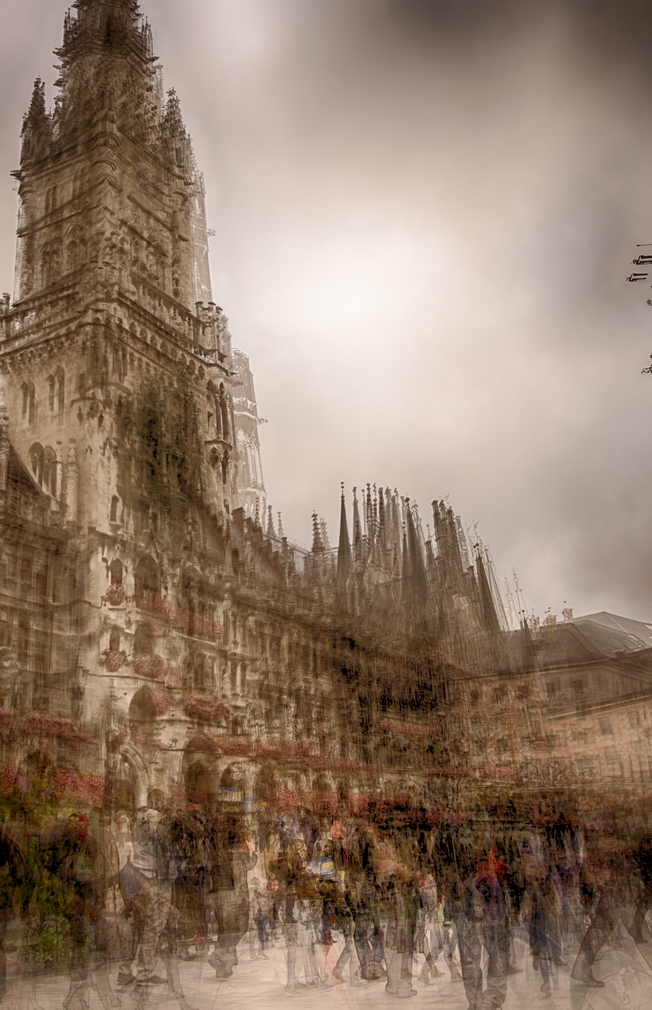
15 minutes to noon, the main square is already packed. Eyes heads up, towards the figurines in the Neue Rathaus tower. Women and men. Giggling children. At noon sharp, the bell starts to ring. However, it is not the Townhall. It comes from behind the square, maybe from St. Peter church, maybe from Frauenkirche, maybe from another church. The Neue Rathaus is still quiet. Tourists first time in München become worry 3 minutes latter when another bell rings. Then it is the turn of another one. One may feel disappointment within the crowd gathered in Marienplatz. And some hope: “We are so many; they could not have fooled all of us”, everybody thinks.

7 minutes past hour, the crowd is happy. The figurines in the bell tower are moving. It was worth waiting. The champions go round, and in the end, one knight wins the jousting tournament, the other being pushed off the horse by the blunted tip of the opponent's lance.

An enthusiastic reaction comes from the crowd. Eyes are glittering, the droplets of rain do not matter, and there is a murmur and a tremor. Nothing like an extraordinary feeling, but smiles and friendly eyes welcome the putting in motion of the second set of figurines in the tower.

For me, the actual show is the crowd, reacting to little thinks. The thrill of humanity sparkled by puppets put in motion by a mechanism designed and built 200 year ago.

The light in the eyes.

Humans, which turn irrelevant politics, pop stars, reeky mobile phones, or stupid radicalisms.

6 octombrie 2016

Calitatea doctoranzilor este dată de calitatea celor ce îi evaluează

Citesc referatele pentru o teză de doctorat în sociologie, la o universitate de ”Top 3” de la noi. Primul referat face copz-paste din teză, nu spune absolut nimic și laudă niște metode statistice de acum 40 de ani. Al doilea referat are meritul de a fi scris de autorul său, dar nu include absolut nimic critic. Prezintă teza, fără a o pune în vreun context. Și recomandă acordarea titlului de doctor. Al treilea referat este în aceeași notă: o trecere în revistă a ceea ce scrie prin capitolele tezei, fără nici cea mai mică referință critică (adică fără nicio apreciere proprie a referentului; este doar o descriere a ce e scris în teză).

Referatul coordonatorului începe precizând laudativ numărul mare de pagini. Are apoi lunga descriere a ce scrie în teză. La final subliniază punctele tari ale lucrării, abia aici găsind primele părți de analiză autentică a tezei, chit că este exclusiv laudativă.

Autorul primului referat este psiholog, al doilea este filosof, al treilea este sociolog. Teza este de psihosociologie.

Citesc în diagonală și teza: modestă, cu probleme de măsurare. Destul de greu de spus dacă rezultatele pot fi replicate. Ipozele sunt banale, iar selecția subiecților este realizată după variabila dependentă, prin urmare, în absența grupului de control, nu poți spune dacă rezultatele raportate sunt corecte. Acum 40 de ani ar mers și așa. Azi, teza a primit calificativul ”foarte bine”, adică maximul, pentru că nu am văzut vreo teză care să primească ”excelent”, dar și minimul, pentru că nu am văzut practic nicio teză care să primească ”bine”.

Pe de altă parte, teza este evident mai bună decât multe altele notate cu ”foarte bine”. Și este mult peste referatele scrise de cei ce ar fi trebui să evalueze teza.

Am propus ca toate referatele pentru toate tezele să fie disponibile online, public.

Sunt curios dacă mă va auzi cineva. Ce epitete voi primi deja știu și mă lasă rece.

Notă. În România, în științele sociale, cred că sunt peste 99% din teze care sunt acceptate imediat ca fiind bune. În alte părți ... a ajunge la susținerea finală este o aventură în sine.

7 septembrie 2016

Double morality


For long communist decades, Romanians learned to say what the Party wanted them to say, and did what they though is "good" to be done. Katherine Verdery explained the mechanism in an excellent book published 20 years ago. Alena Ledeneva depicted a similar set-up in the Russian society, and named it "double morality".

What struck me yesterday was the perpetuation of such practice.

Water and Water
Defitively alike!
On one hand, there was this guy, a young apparently socialist politician, head of a self-made IT imperium, accused to heavily corrupt Government officials. More exactly: most of his money seems to come from arranged contracts with the state. He is under investigation by various judicial bodies, apparently being on the verge to be re-imprisoned.

In this context, I watched some public declarations that he gave in a parking. The ladies-reporter to ask questions seemed to enjoy his opening misogynistic statements, meant to create some bonding with them, the reporters.

Then, he started to preach democracy, accusing almost everybody to be against Romania being like Germany. He pointed to civic society as a whole for being sold to " the American that brings Syrians to Romania" (this is George Soros). And claimed to be the one to have the courage to say the truth ...

Second, the Government proposed a change of the taxation law. Up to now, out of the budget for salaries, the employer paid a certain percentage to the public social insurance found. The transfer was formally recorded into two distinct amounts: one was said to be paid by the employer, the other by the employee. Let me take an example. Let say the total wage costs that an employer makes for Ion Popescu is 100 lei. Nowadays, the employer pays to the found something like 14 lei - labeled as "employer contribution", and 13 as " employee contribution". According to the new proposed law, Ion Popescu will pay 22 lei instead of 13+14=27. This reduced contribution is labeled as "employee contribution".

The proposed change has the obvious effect to bring salaries in public sector closer to the ones in private companies. Most likely, many private employers may want to keep the resulting 5 lei difference, since the contracts with the employee do not include the "employer contribution". In the public sector, one should expect a slight increase in the net salary: the difference will go to the employee.

Romanian media argued against the proposal. They say it increases the fiscal burden. In a way this is true: Romanian journalists are poorly paid, and they work as individual contractors, not as employees. In other words, they did not pay up to now the "employer contribution". For them, the new rule would alleviate fiscal evasion, and would decrease their incomes.

mirrored reality
The same applies to other professions as well. However, media is an interesting example. Most journalists are young and very young. They had almost anything to do with communist times. But they also learned to claim they defend rule of law. And they actually do it vocally.

For instance, it comes to mind the example of this journalist paid about 10 times the average wage, in net salaries, but who avoids paying full taxes, as other people do. The journalist constantly self-presents as defender of democracy, attacks the ones like the above politician, and subtly suggests to be the one who follows the rule of law.

We can pretend the water is clear.
But is it clear?
By the end of the day, both the journalist and the politician reproduce the dual morality, confirming what we know from social sciences ... Culture is stable overtime.

12 august 2016

Opt

Atât de multe lucruri te pot schimba în opt ani. Partide, guverne, echipe de fotbal, recesiuni, vieți. Oameni. Buni, răi, nu contează. Viețile se întrepătrund, minuscule, iar lumea merge Înainte. Sau Înapoi, depinde de perspectivă. Nici măcar perspectiva nu contează. Privită de sus lumea este mereu la fel. Cu sau fără o viață.

4 august 2016

Her (aka And I Miss Her)

I missed her. After so many words between us … she did not show.

I went through the alleys with her sight in my heart, crossing the green, almost floating, like a fluffy cloud pushed by the wind, like a whiff through the hair of so many kisses. It´s summer, the park is vivid all night long. A bunch of teenagers, playing a guitar, two blonde women remembering storing from their youth, a dark curly one, kissing some placid guy, another blonde, dark eyes, getting out of the car, with her beau, hand in hand, the guardians sweeting in their uniforms, three dogs, and their masters, another couple kissing. The beauty of crickets, playing their songs, a drummer whispering words of love, a tired captain admiring the hips of his young future-wife, smiles, bright eyes, shortness of breath, young people, not-so-young people, dogs, laughing, happiness, joy. But she … she did not come. Another alley, then a new one, I repeat the round. The same faces, enjoying life, in the shadow of the night, with so many clouds looking through the stars, floating…

I really missed her. She used to chase me at every single trip into the park. She blinded me with the brightness of her eyes. She pushed me in a bush, once. She was everywhere, at every hour, mingling and mangling my life. But tonight … she did not come.

I was calling her names. Mihaela, Cristina, Vyanna, Mayflower (why not?), Rainbringer (yap!), Golden Blue… I was speeding up. The best time since my injury, told the voice in my ear, while I was rolling thinking of her, trying to understand... A certain number of minutes per lap, or per kilometer, who cares?

Suddenly, a girl jumped in front of me, scared by a barking dog. She made me fall dow, the seventh time in 36 years.

She did not come!

Garbage bags all over the alleys waited for her, but she, the cleaning car (did I say that Romanians are romantic enough to have no “it” in their language and to call cars as “she”?), she did not come…

It was my chance, to think clearly, behind this screen, through fluffy clouds and happy crickets, over the street and a little farer. The words came easy, although in a clumsy dance, one thousands at once, like a girl with one thousands delightful faces, and I missed her.


PS. Part 1 was written in Romanian, one year ago ...
PS2. I also miss a kriek, like old times (the soundtrack is Deep Delta - Private Number). Maybe this is why I am so clumsy in writing tonight?

27 iulie 2016

Magna cum summa

Accepți să faci parte dintr-o comisie de doctorat. Citești teza. 100 de pagini. Cât timp vă ia în mod normal să citiți 100 de pagini? Adăugați acum timpul pentru a le înțelege ca atare, pentru a te duce la alte lucrări din același domeniu pentru a-ți reîmprospăta amintirile despre ele, pentru a vedea dacă este ceva de reținut din spusele candidatului. Este o teză de doctorat, candidatul a muncit și merită să fie citit cu atenție, are nevoie de comentarii pertinente pentru a putea crește.

În Anglia, aproximativ 75% din teze sunt respinse la prima citire, fie în comisia internă, fie în cea cu referenți externi*. Respingerea a doua sau a treia orară sunt practici frecvente în științele sociale. În România, senzația mea este că procentul de respingere este de sub 2%. Este vorba, fără îndoială, de o altă cultură a doctoratului. Ea poate avea în spate o calitate mai ridicată a activității doctorale la noi. Sau o toleranță mai mare.

În România, nu am reușit să persuadez nicio comisie să dea mai puțin de „foarte bine”, indiferent cât de slabă a fost lucrarea candidatului. Calificativul maxim ce poate fi acordat este „excelent”.

Pentru o teză bună, de 100 de pagini, un referent care o citește cu atenție petrece măcar o zi lecturând-o. O teză bună este plăcută la lectură, fiindcă înveți din ea, îți pune mintea la contribuție.
Se mai adaugă scrierea referatului, îndeplinirea procedurilor birocratice, participarea la susținere. Cam încă o jumătate de zi.

Ești și plătit pentru asta. Dacă ne gândim că petreci minim 12 ore cu o teză de 100 de pagini, plata este exact la nivelul salariului mediu pe economie. Dacă este vorba de o teză de 300 de pagini, plata ajunge sub jumătatea salariului mediu. Mai ales dacă este o teză proastă sau mediocră, tentația de a minimiza lucrul este imediată. Nu citești totul, iei un referat gata făcut și schimbi câteva fraze. Dai notă mare, ca să previi nemulțumirea candidatului. Apoi nu poți da notă mai mică unei teze un pic mai bune, fiindcă deja ai impus un standard de notare ridicată. La final, toți sunt câștigători: și-au furat cu grație căciula unii altora.

La fel sunt și notele date de români pe site-uri precum booking.com. Majoritatea evaluărilor merg de la 8 în sus, de parcă notele mai mici ar fi ciumate. Relevanța ratingurilor scade automat: nu mai este suficientă variație. Informația adusă de aceste note este minimă. La fel să fie și acoperirea cu calitate a titlurilor de doctor?

Universitatea îți cere și ea niște hârtii pentru onoarea de a face parte din comisie:
• O copie după cartea de identitate
• O declarație pe proprie răspundere
• O adeverință de salariat
• O hârtie de la bancă din care să reiasă ce cont ai
De ce nu o fi suficientă declarația ta care specifică și locul de muncă, și detaliile din cartea de identitate, și contul bancar??? 

Toate aceste hârtii se printează. Trăiască copacii și spațiile de depozitare! Dacă revii peste două săptămâni la altă comisie de doctorat la aceeași universitate, trebuie să le produci din nou. C-așa-i în tenis, vorba lui Toma Caragiu.

Ceremonialul hârtiilor pare a avea simplul rost de a ascunde ceremonialul susținerii. Un eveniment plat, în care întrebările și răspunsurile sunt lipsite de rost, din moment ce rezultatul se știe de dinainte.

În Anglia, dacă primești un „minor revisions” (adică „refă câteva aspecte din lucrare și vino din nou”) ești un candidat de succes. În România, dacă unul dintre cei trei referenți din comitetul de susținere propune un calificativ mai jos de „foarte bine”, înseamnă că acel referent este unul de disprețuit. „Nu se face așa ceva în public”, mi s-a spus.

Poate de aceea atrage România atât de mulți studenți străini. Dar eu oricum nu mă pricep, prin urmare nu este cazul să mă băgați în seamă …


PS. Revin peste câteva zile cu o postare despre cum cred că s-ar putea restructura ceremonialul școlilor doctorale.


* Nu am o statistică oficială cu privire la această cifră. Mă bazez doar pe ceea ce am aflat de la varii colegi. Orice corectură este binevenită.

23 iulie 2016

The new old social wars

A 13-year-old boy was decapitated in Syria, by rebels. He was labeled as being the enemy.

A mother and her three daughters were stabbed by a Moroccan man in southern France, for taking sun baths. They were labeled as being indecent.

Paris, Zaventen, Islamabad, Nice, Istanbul, Bagdad, Munchen …

In recent months, there was an uncontrolled attack almost every single week. People died all over the world. People could not enjoy life because other people believed they do not follow a traditional rule.

The US experience every few months an armed attack, in which Americans use guns against Americans, just for showing their power. Typically, the aim is a high school or a college.

Killing youth and children has this ancestral symbolic meaning that one cuts the roots of the evil, by expelling the heritors out of this world. This was pretty much the most important survival rule in the dark ages of the Middle Age. Bloody examples may be found in the Bible and Quran. And this is the most simplistic way to solve an imaginary problem: killing.

Breivik is the best-known example, since he was coming from a society that puts less price on such habits, and actually ejects them. But he occurred and acted in a “barbarian” way...

The more such killings, the more examples one has to follow ...

Parties such as UKIP and FN, politicians of various orientations constantly exploit the niche. They provide traditional individuals with traditional ways of solving problems. Keep the borders closed, send people to churches, eliminate freedom of speech, blame the liberals as being the enemies, and the socialists to be against the traditional law as well. Blame the system is the newer manifestation of such tendency, a sort of extremism à la carte.


Pierro Ignazi explained it 20 years ago, discussing about the silent-counter revolution. When important parts of society move towards more freedom, trust, and focus on the individual as a human being, not just another …. part of the society, the most traditional people voice up. They back traditional solutions to restore the old order. The one in which all are the same, as an army of identical soldiers. The new chaos, of whose rules they do not master, is proposed to be replaced by the old order. They attempt to block freedom of movement and speech. They call for religious obedience. They ask for less liberal education. They provide populism. They promise development. Hitler did it the same way. He is the salient example. But his not an exception. Au contrary. As Inglehart and Baker noted, when a threat is visible, many retreat to more traditional values. This is what populists of all orientations are awaiting. They seize the opportunity, start blaming “the other”, find the exploit in the weakness of a political system rotten by corruption and mediocrity, but forget saying they are the same in this respect. They attempt to take power and in many cases they manage to. Eventually, their failure leaves a huge paying bill for society, and regular people start asking how it was possible that they get deceived.

The new social war hits modern civilization in its basic foundations: tolerance, rule of law, trusting people, individual freedom, pursuing knowledge. This is the great ISIS victory: we turn back towards traditionalism, we choose a new Middle Age. See the Brexit, to coin a single example. (I do not refer Brexit as the separation of the UK from the EU, but as an act to legitimize the interests of the traditionalist camp).


===========================


Social science can teach us about such stories. Social science can explain how societies fail, and can enable prevention of such failure. Social science cannot fully prevent terrorist attacks, but can enable societies to defend against them and to minimize the effects. This why one needs studying societies, in particular in a comparative perspective. One needs to consider all variables, to contrast what happens somewhere else with what happens in one’s own courtyard, and to quickly react by enabling decision makers and regular people to understand where they are and follow informed solutions and policies.


This is part of what we tried to explain the Romanian Agency for Scientific Research, a couple of months ago, in the context of the almost total exclusion of social science from financing in the national research plan valid until 2020. The reaction was polite, but we learned that we were not convincing enough to persuade the Agency to allot about 120,000 Euro yearly for comparative research (this is less than the total yearly expenses of a Romanian football team to play and avoid relegation from the 4th League!!). Therefore, I start today a series of public postings that aim to provide compelling examples. If anyone wants to join, please e-mail me. Any collaboration is more than welcome.

Convorbire telefonică cu ... un hoț??

Sună telefonul, de pe un număr necunoscut, vizibil (adică nu este ascuns), iar o voce de bărbat mă angajează în următoarea convorbire: -  ...